


LNG stands for “liquefied natural gas”. This is natural gas that is liquefied by cooling it down to -160 °C. In its liquefied state, it takes up only 1/600 of the volume of natural gas. This makes it very easy to transport on special ships so that many production sites around the world can serve as sources. Once it is heated again, it re-turns to its gaseous state.
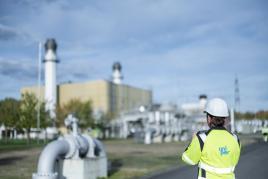
LNG terminal Wilhelmshaven
Our path to a climate-neutral future. Security of supply for Germany.
Completed in record time: Germany's first LNG terminal
In 2022, Uniper did some pioneering work to make Germany more independent and secure its energy supply. With the construction of the superstructure for Germany's first LNG terminal, combined with the construction of a new jetty and the laying of a new 263 km natural gas pipeline, a floating storage and regasification unit (FSRU) was able to commence operations in Wilhelmshaven. Uniper built the terminal in a very short time together with its partners Niedersachsen Ports (NPorts) and Open Grid Europe (OGE).
Since 2023, Uniper subsidiary LNG-Terminal Wilhelmshaven GmbH (LTeW) has been operating the terminal on behalf of the federally owned company Deutsche Energy Terminal GmbH (DET), which acts as the operator. Uniper has thus made an important contribution to greater independence from individual energy sources and a sustainable energy future in northern Germany.

FAQ's related to LNG-project in Wilhelmshaven
Here we answer the most frequently asked questions in the areas of supply security, future energy, project location, realization plan related to the LNG project in Wilhelmshaven. If you still have any questions left which are not answered on this page, our contact persons will be happy to assist you at any time.
General FAQ's
FSRU is the abbreviation for the technical term "Floating Storage and Regasification Unit" (FSRU). This is a floating landfall terminal for liquefied natural gas. This terminal is a special vessel that receives LNG from arriving vessels and converts it back to its gaseous state.
In order to overcome the energy crisis, a floating landfall terminal for liquefied natural gas (FSRU) was built at the Voslapper Groden industrial site in Wilhelmshaven. The FSRU „Höegh Esperanza“ received a fixed berth at the existing transshipment facility. The supplied natural gas will be fed into the vessel, where it will be converted back to its gaseous state. The gas will then be fed into the German gas transmission network (Netra) near Etzel via the „Wilhelmshavener Anbindungsleitung“ (WAL) - a 26-kilometer link that has been constructed by OGE (Open Grid Europe).
A floating storage and regasification unit (FSRU) has many advantages as compared to an onshore terminal. Building a floating terminal is fastest. Thus, LNG energy supply in Germany was implemented shortly after the start of the Russia-Ukraine war at the end of 2022. Another benefit is the low impact from construction operations and construction noise. All in all, the floating terminal is comparatively space-saving and is located in a purely industrial area. Another benefit is the mobility. Since the FSRU is a fully operational vessel, it can leave for the open sea at any given time. From afar, it is visually indistinguishable from other vessels at the oil pier or the JadeWeserPort.
Security of supply
The current geopolitical situation has once again highlighted how important it is to diversify not only sources but also import routes. The implementation of an LNG terminal in Germany contributes to the country's security of supply.
The European Union was striving for greater independence from Russian gas by increasing LNG imports. By the time the Ukraine invasion started in February 2022, 21 LNG terminals were being used in eleven European countries. At least 19 additional projects were quickly planned. The turning point in the European gas market was taking shape. The letter of intent signed by the German government and the state of Lower Saxony specified the chartering of a total of four floating LNG terminals (FSRUs). Thus, the realization of the first LNG terminal in Wilhelmshaven - in contrast to the 2019 plans - was primarily a political project. Uniper was primarily helping the Federal Republic of Germany out of the energy crisis created by the political constellation, based on its expert knowledge as an international energy company and the leading gas company in Europe. In this context, Uniper is currently implementing the construction of a floating landfall terminal for liquefied natural gas in the form of the superstructure and initially took on the role of operator. Uniper now manages the terminal through its subsidiary LNG Terminal Wilhelmshaven GmbH (LTeW).
The construction of a landfall terminal for liquefied natural gas in Germany contributes to security of supply. In the context of supply security and price stability, Germany benefits from the diversification of supply sources and the avoidance of one-sided dependencies: LNG enables access to new suppliers and can thus contribute to security of supply.
Natural gas can be found and extracted on many continents around the world. This gives Germany the advantage of becoming less dependent on individual producers. Market participants decide which sources the LNG arriving in Wilhelmshaven and other LNG terminals in Germany comes from, based on supply and demand. The most important exporters of LNG include the USA, Australia, and Qatar.
Future energy
The use of liquefied natural gas to ensure the energy supply in Germany serves as a bridging technology toward a sustainable future. LNG is a short-term guarantee for Germany's reliable supply. However, the long-term goal of a sustainable energy supply is still kept in mind. This may be achieved by using hydrogen as an energy source.
When planning and implementing major infrastructure projects, such as the LNG terminal in Wilhelmshaven, we at Uniper SE took and take the criticism, concerns and legal objections of citizens' initiatives and environmental associations very seriously, provided they are presented objectively. All objections were carefully considered and all appropriate and necessary steps were taken to minimize the impact on the citizens and the interference with nature and the ecosystem that may be associated with the construction of technical facilities. All this was done in close coordination and with the involvement of the relevant approval authorities.
Uniper and its project partners built Germany's first LNG terminal in Wilhelmshaven with the aim of rapidly diversifying gas sources to strengthen Germany's security of supply. At the same time, Uniper is preparing for the landing and import of ammonia via a hydrogen import terminal as part of the Green Wilhelmshaven project. This facility is to be linked to an ammonia cracker on land, where the ammonia will be converted back into green hydrogen for feeding into the gas grid/H2 pipeline. Commissioning is planned for the first half of the next decade.
As the final step on the road to a climate-neutral future, a large-scale industrial electrolysis plant is to be built on the site of the former Uniper power plant. Its capacity is expected to be in the gigawatt range. At the same time, Uniper SE is realizing its vision for the future, which is based on the triad of security of supply, diversification, and sustainable transformation.
LNG imports via FSRUs are the beginning of the bridge towards a hydrogen future and a CO₂-free decarbonization era.
Location
With its deep shipping channel, the nautical area near Wilhelmshaven can be navigated independently of the tide in Germany's only deep-water port. This means that the floating terminal can be approached at any time by LNG transport ships of any size. Yet the jetty is far enough away from the shipping channel not to interfere with maritime traffic. Adding to this advantage is the ideal infrastructure connection to the gas pipeline as well as the highway and rail network. Besides, the feed point to the German long-distance gas pipeline network and to the storage caverns in Etzel also made the nautical area near Wilhelmshaven the ideal location for an LNG terminal. In addition, the location in a port area already used for industrial purposes guarantees the highest safety standards.
Wilhelmshaven played a special role in the energy crisis. This region is supposed to become an energy hub for Germany, from which natural gas can be supplied to the rest of the country. Thus, Wilhelmshaven will continue to contribute to the supply reliability of the energy sector, with the import terminal handling 6 percent of Germany's future gas requirements. While the short-term energy supply is to be ensured by LNG, the long-term plans involve green hydrogen energy supply. At the same time, the floating terminal will create and secure jobs and strengthen the local economy.
Realization
The LNG terminal model regasifies LNG via an FSRU that could be connected to the existing Voslapper Groden transshipment facility (UVG). There, the LNG is converted into gaseous natural gas. The gas is then fed into the German natural gas pipeline network.
To do this, the existing UVG had to be adapted and a connection established between the FSRU and the onshore facilities (known as a ship-to-shore interface). The adaptation of the UVG was carried out by Niedersachsen Ports GmbH & Co. KG (NPorts) in close cooperation with Uniper.
The connection to the natural gas pipeline network 26 kilometers away and thus also to the Etzel natural gas storage facility was realized by Open Grid Europe GmbH (OGE) and was completed quickly. With a capacity of up to 5 billion m³ per year, around 6 percent of Germany's natural gas requirements can be landed in Wilhelmshaven.
Future plans
Uniper is planning a hydrogen import terminal for the decarbonization of industry and energy transformation. This requires additional unloading and transshipment facilities for green gases, such as ammonia, via a new jetty for liquefied gases. The green ammonia can be transported directly by rail or converted back into hydrogen on site using so-called crackers.
The implementation of such a bridge technology is based on all legal requirements. For the LNG project in Wilhelmshaven, this phase will last until the third quarter of 2022. Parallel to the planning phase, a comprehensive approval process is underway, in which the project is being reviewed in detail by the relevant authorities and agencies. The approval procedures cover all relevant aspects and include a planning approval procedure, an immission control procedure, including an environmental impact assessment, and water law approvals. In order to achieve rapid implementation of the LNG energy supply, the awarding of contracts and the construction of the onshore infrastructure and superstructure, for which Uniper was responsible, took place in parallel. The approval procedures and construction were synchronized, with the procedures running in parallel at state and federal level. Everything went according to plan: The Wilhelmshaven 1 LNG terminal was officially opened and commissioned on December 17, 2022.
The goal was to secure Germany's energy supply after the invasion of Ukraine and, in time, reduce its dependence on Russian natural gas. As with all projects, detailed and in-depth experts' opinions were obtained in conjunction with the planning and approval procedures in order to ensure that the proposed activities meet the applicable regulatory requirements and satisfy all approval conditions. The project completed all the procedures that were also previously necessary for approval. The only difference was that the procedure was completed more quickly. However, none of the steps were omitted or simplified. "If there is a chance in this really terrible situation, it is that we shake off all this sleepiness and, in some cases, grouchiness that exists in Germany," explains Robert Habeck, Federal Minister of Economics.
The framework for accelerated completion was created by the so-called LNG Acceleration Act which came into force on June 1, 2022. The law provided for new regulations. These speed up approval, award, and review procedures so that land-based and floating LNG terminals and the necessary pipelines could be built more quickly. In order to cope with the gas supply crisis, the law allowed certain exceptions from the environmental impact assessment requirement. Public participation took place. Thus, construction of gas pipelines and the necessary infrastructure for liquefied natural gas terminals could start this summer.
Uniper is the largest German LNG dealer. Germany is already considered to be the gas hub of Europe, due to its favourable geographic location and its good transport and storage infrastructure. LNG terminals connected Germany even better to the global gas markets. Uniper can draw on more than 45 years of experience in LNG infrastructure and large-scale power generation in Wilhelmshaven. The use of LNG for energy supply is an established technology that has been used throughout Europe for years. Both onshore and FSRU-based import terminals have been extensively investigated and studied during the past decades.
A combination of four strong partners guarantees fast and competent implementation:
- Uniper was responsible for the ship/land connection for the FRSU “Höegh Esperanza,” the superstructure up to the natural gas feed-in point in Voslapp, and the approval process.
- Takeover of the jetty and extension for green energy was carried out by Niedersachsen Ports (Nports).
- The 26km long connection line was implemented by Open Grid Europe (OGE) in the short term.
Info office
Germany
Info Office LNG Project Wilhelmshaven Medienhaus JadeWeser
Germany
Press contact
Julia Grebe
Spokesperson / Head of Stakeholder Management Northern Germany
+491707159505
